


Space taxation and space tourism
At My Accounting Now, we believe in empowering business owners with the knowledge and tools they need to thrive. Our blog serves as a resource hub, offering insights into critical aspects of business finance, from effective bookkeeping practices to strategic tax planning. By staying informed and proactive, business owners can avoid common pitfalls and leverage financial strategies to fuel their growth and success.
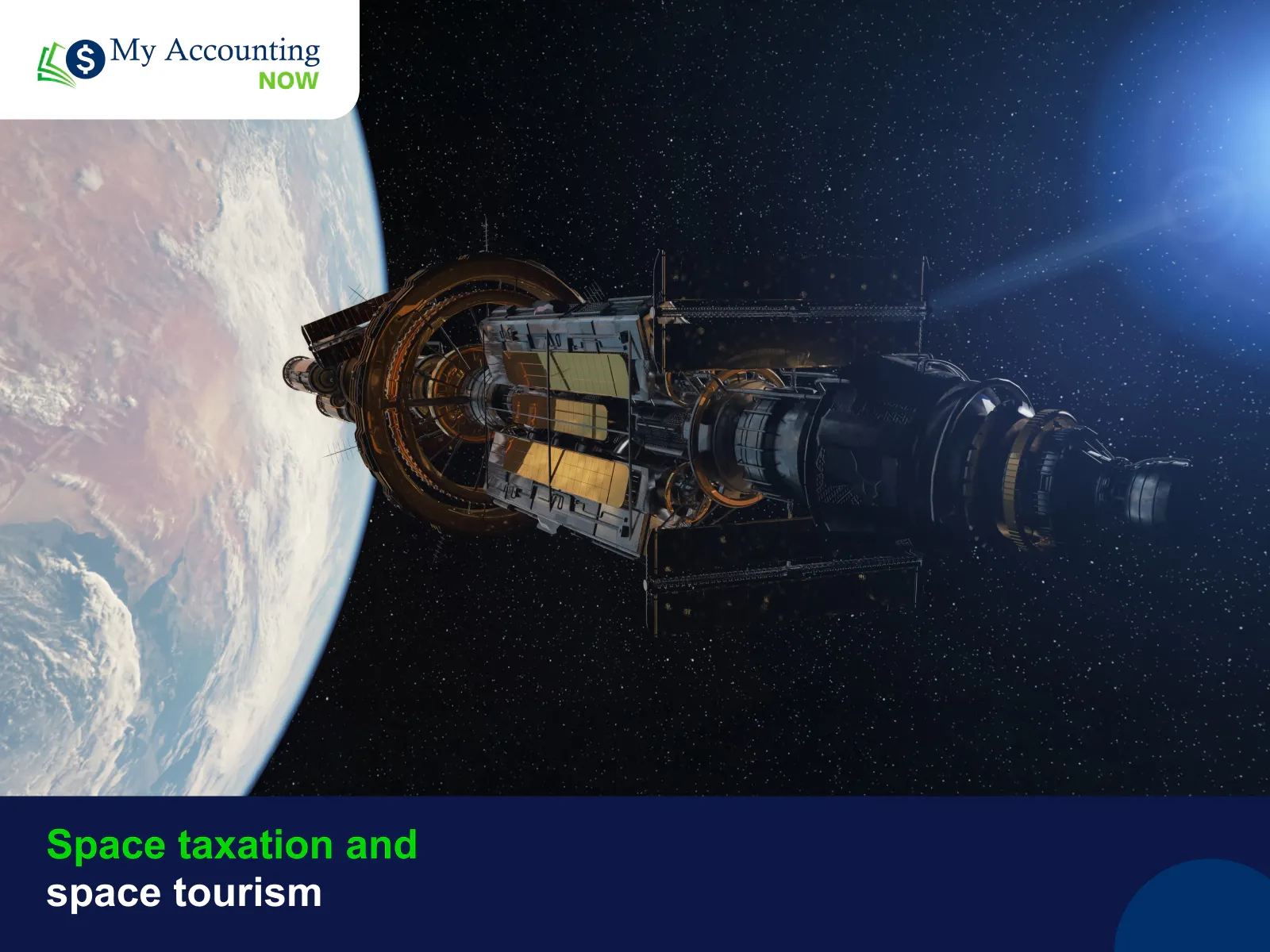
Space taxation and space tourism
2025-12-19
Space, for decades the exclusive domain of state agencies, has become a new commercial arena. Companies like Blue Origin, Virgin Galactic, SpaceX, and Axiom, among others, already offer space travel (suborbital and orbital tourism, stays on private space stations), and a space economy is emerging that includes asteroid mining, resource extraction on celestial bodies, and satellite services such as mega-constellations. This raises unprecedented tax questions: How should these activities be taxed? What laws apply when revenues, passengers, and resources are located “outside” the territorial boundaries of any state?
Current Status: Activities, Drivers, and Market
Some recent data that help to understand the magnitude:
- The US space tourism market is projected to reach approximately US$3.402 billion by 2030, with a compound annual growth rate (CAGR) of ~42.4% between 2024 and 2030.
- Tickets for suborbital flights will cost between US$200,000 and US$450,000 per seat, depending on the company. For orbital flights (for example, to the International Space Station), some prices reach US$55 million per passenger.
These figures show that space tourism is no longer science fiction but an industry with significant revenues, which is prompting regulators to examine its tax treatment.
Main tax challenges
- Jurisdiction and Source of Tax: Where is the income considered to be generated? On Earth, in orbit, at a lunar base, or on an asteroid? Traditional tax rules (residence, territorial source) become complicated when economic activity occurs outside national sovereignty.
- International treaties and space law: The 1967 Outer Space Treaty, signed by the U.S. and other countries, declares that space cannot be subject to national appropriation. However, it does not explicitly address taxation. There is no clear international regime for taxing commercial space activities beyond airspace; treaties focus on responsibility, peaceful use, non-appropriation, etc.
- Recent regulatory proposals: In the U.S., Congressman Earl Blumenauer has proposed a specific tax for commercial spaceflights that transport humans for purposes other than scientific research. This would include excise taxes per passenger and differentiation based on the altitude of the suborbital flight. Another type of proposal is to apply carbon taxes or environmental charges given the high emissions footprint of certain space launches.
- Other aspects, space mining and extraterrestrial resources: The U.S. has already passed the Commercial Space Launch Competitiveness Act of 2015, which recognizes the right of U.S. citizens to explore and exploit space resources, always subject to regulatory oversight. However, there are no specific federal tax rules regulating how to tax profits derived from these resources or how to distribute them if they are international entities.
Analysis of critical issues
- Tax equity: Many of the early users of space tourism are very wealthy individuals. Tax proposals seek to ensure that this new “form of luxury” also contributes to the public good.
- Environmental impact: Space launches emit CO₂ and other pollutants in large quantities. There is concern that tourist flights will increase this burden, which motivates proposals for environmental fees or specific carbon taxes.
- Regulatory uncertainty: Both companies and investors face legal risk due to the lack of clarity regarding tax rates, ownership of space resources, and international tax obligations.
Policy perspectives and proposals
- Special tax on space tourism: an “excise” tax per passenger, differentiated according to flight type (suborbital vs. orbital) and altitude, as proposed by Blumenauer, could be an intermediate measure to capture part of the economic and social value (including environmental impact).
- Taxation of space resources: create fiscal rules (national and international) for the exploitation of resources on celestial bodies, how to value resources, and who has the right to collect taxes or royalties. Also, establish an international legal framework similar to maritime law (e.g., for platforms under limited jurisdiction) for the exploitation of space resources.
- Environmental charges & externalities: consider taxes based on emissions or the environmental footprint of launches, including compensatory measures. Proposals that address external effects such as orbital pollution and the risk of space debris. Example: an “orbital use fee” (“orbit tax”) that taxes satellites in orbit based on collision risk or trajectory.
- International cooperation and treaties: To avoid unfair tax competition, evasion, or loopholes, international coordination is needed: space taxation agreements, taxation of companies operating in multiple jurisdictions, and common standards. This could potentially be under the auspices of organizations such as UNOOSA, the OECD, or through ad hoc treaties.
Considering all this, the taxation of space and space tourism is an emerging frontier that combines international law, corporate taxation, environmental taxation, and social justice. By 2025, concrete ideas such as space tourism taxes, laws permitting the exploitation of space resources, and discussions on environmental fees have already been proposed, but the legal landscape is far from clear or uniform. For this space economy to be sustainable, fair, and efficient, a clear national legal framework will be required that defines tax obligations for tourist flights, space mining companies, and commercial users; international cooperation to standardize criteria for jurisdiction, ownership, taxes, and externalities; and the incorporation of the true environmental cost of space activities into the tax structure.